Autonomous Thymio: localization that survives a blindfold
TL;DR
- Problem
- Reach a goal on a 100 × 70 cm arena and avoid mapped and surprise obstacles, using one overhead camera that can be covered and odometry that drifts.
- What we built
- A camera + odometry navigation stack for a real Thymio. My module: the Extended Kalman Filter over [x, y, θ] and its noise identification.
- Result
- Validated live in three scenarios: a nominal run with a surprise obstacle, kidnapping, and camera blackout.
- Stack
- Python, FilterPy, OpenCV (ArUco), NumPy/SciPy, NetworkX, tdmclient
A small robot has to reach its goal with a camera that can be blocked and wheels that drift.
- BLACKOUT ✓ · KIDNAP ✓
- EKF
- Sensor fusion
- OpenCV
- Real robot
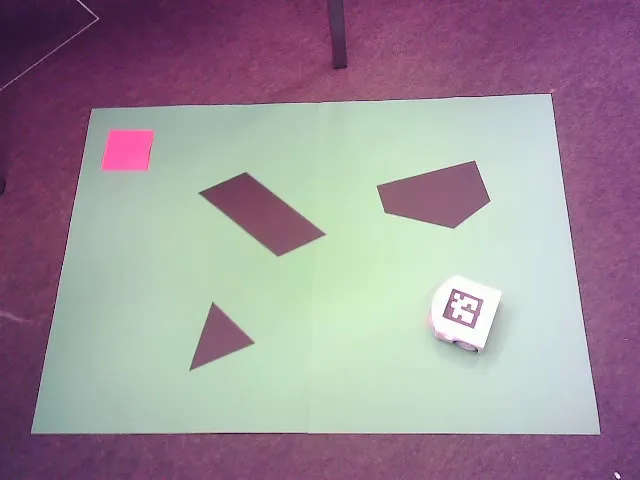
The approach
- Vision (team). OpenCV thresholding finds the map, obstacles and goal; an ArUco marker on the robot gives its pose from the overhead camera.
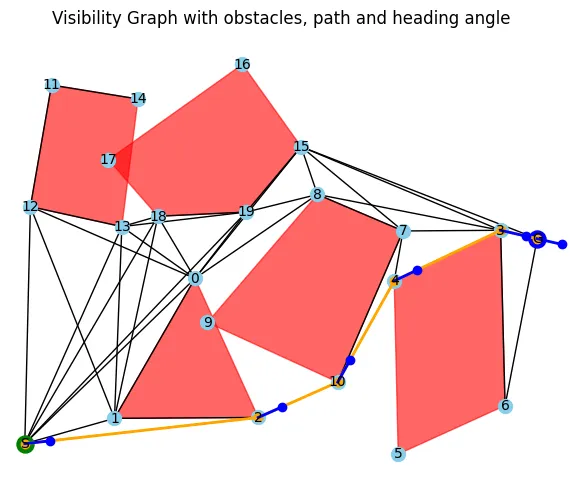
- Planning (team). A visibility graph over the inflated obstacle corners and Dijkstra give the global path; proximity sensors handle surprise obstacles.
- Estimation (mine). An EKF over [x, y, θ] with a nonlinear differential-drive motion model and wheel speeds as input, corrected by the camera pose whenever it is available.
- Noise from data (mine). Camera covariance from repeated marker readings against ruler-measured positions; wheel noise from commanded against measured speed at 10 setpoints.
- Fallbacks. Without the camera, the filter runs on odometry alone. A jump of more than 20 cm between camera fixes is treated as a kidnapping and triggers a new plan.
What it achieved
- Camera + odometry fusion. The filter runs inside the robot’s live control loop on a 100 × 70 cm arena.
- Wheel speed calibrated from 10 setpoints: v [cm/s] = 0.0268 u + 0.4754, in Thymio motor units u.
- Process noise from input uncertainty. Q = B Σᵤ Bᵀ + Q_model. I kept the nonlinear motion model after simulation showed a larger heading error with the linearized one.
- 3 live scenarios passed: surprise obstacle, kidnapping (> 20 cm jump detected and replanned), and camera blackout.
Footage & figures
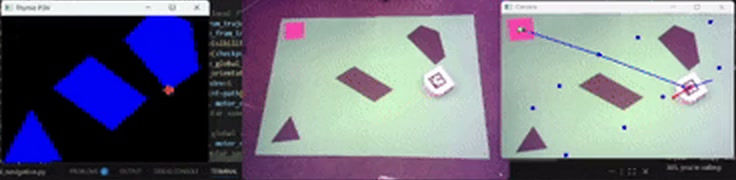
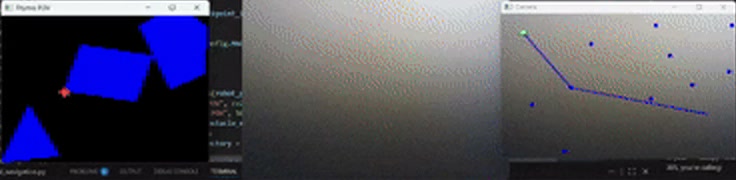
Notes
Team of 4 with one module each: global navigation and motion control, local navigation, vision, and state estimation (mine). The planning figure and the demo recordings show the whole team’s stack.