Quadruped locomotion with CPGs + deep RL
TL;DR
- Problem
- Pure deep RL on legged robots tends to reward-hack into jerky gaits that don’t carry over to new terrain such as steep slopes.
- What we built
- Coupled Hopf oscillators (central pattern generators) set the rhythm, and a PPO policy learns to modulate each leg’s frequency and amplitude, trained with a slope curriculum and randomized friction and sensor noise.
- Result
- Stable locomotion on steep inclines (29% slopes) and at high speeds, with physical footstep accuracy improved by nearly 9%.
- Stack
- Python, PyBullet, Stable-Baselines3 (PPO), Gymnasium, NumPy
Can a rhythm generator borrowed from biology make deep-RL gaits smoother and more robust?
- 29% INCLINE · ≈16°
- Deep RL
- PPO
- PyBullet
- CPG
The approach
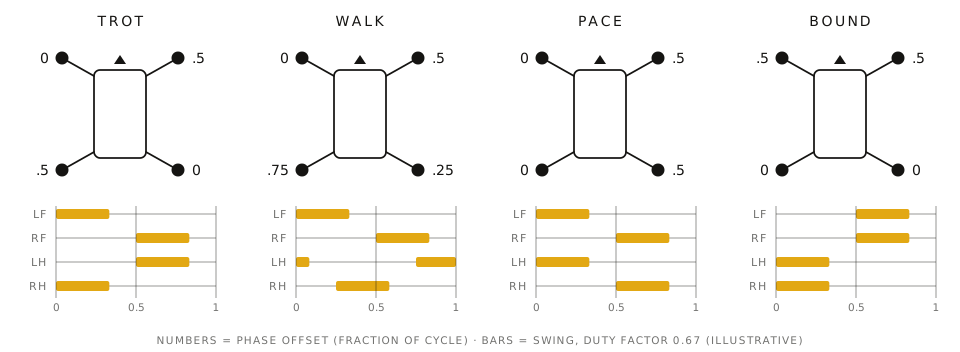
- Rhythm. Four coupled Hopf oscillators produce trot, walk, pace and bound gaits. Their states map to foot trajectories, then to joint torques through inverse kinematics and PD control.
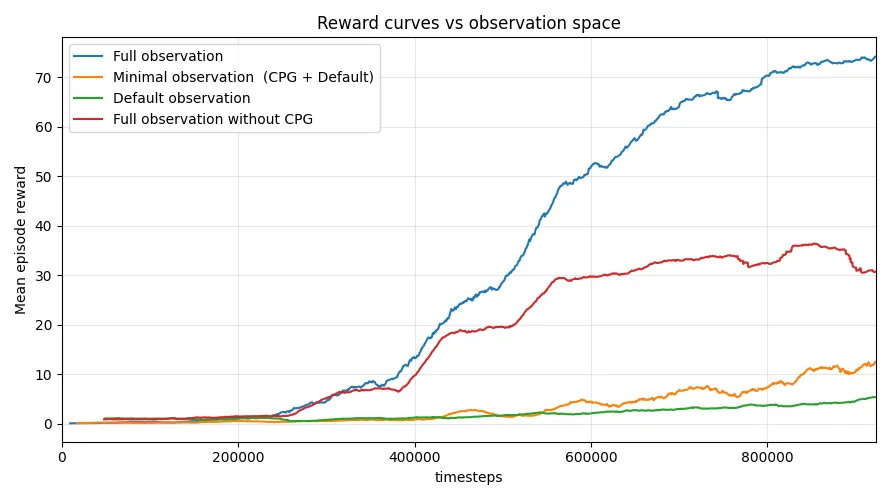
- Interface. The policy observes foot contacts, joint states, base orientation and velocity, plus the oscillator states. We tested multiple action spaces: 8-D CPG modulation (frequency and amplitude per leg) against 12-D Cartesian foot targets.
- Algorithm. PPO from Stable-Baselines3, chosen over SAC after a head-to-head test, then tuned with hyperparameter and network-size ablations.
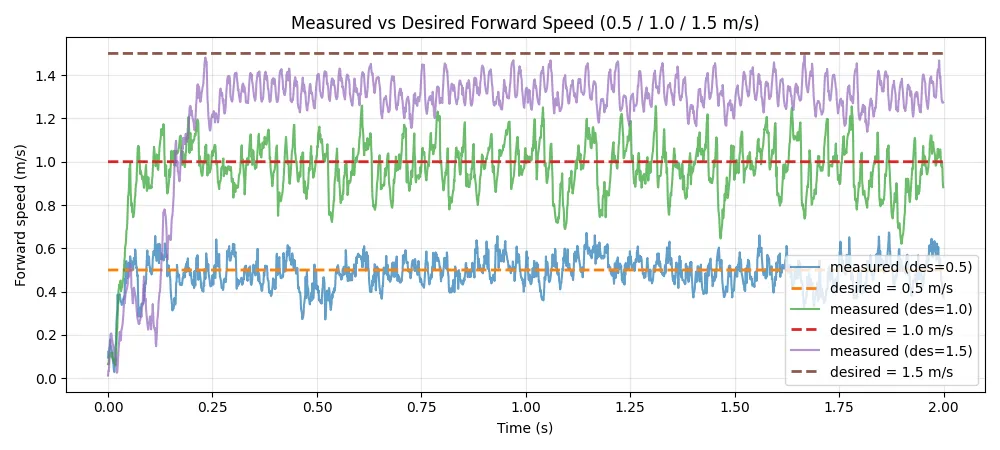
- Rewards. Velocity tracking at 0.5, 1.0 and 1.5 m/s. On slopes: forward progress minus lateral drift, torque, roll and yaw penalties.
- Curriculum. 10% incline, then random 15–25%, then 25–35%, with randomized ground friction (μ 0.5–1.0) and observation noise.
What it achieved
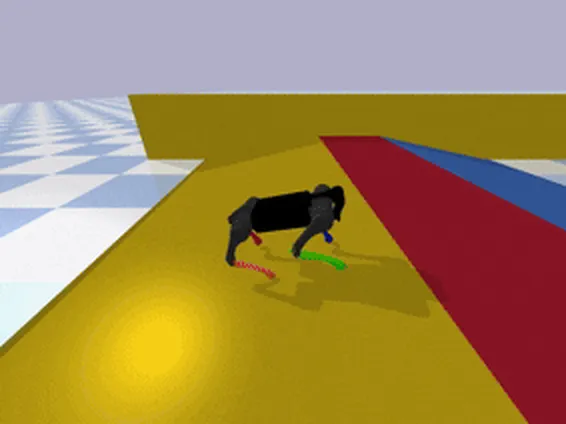
- 29% slopes (≈16°). The adaptive curriculum raised the steepest slope the robot could traverse from 24% with fixed-slope training to 29%.
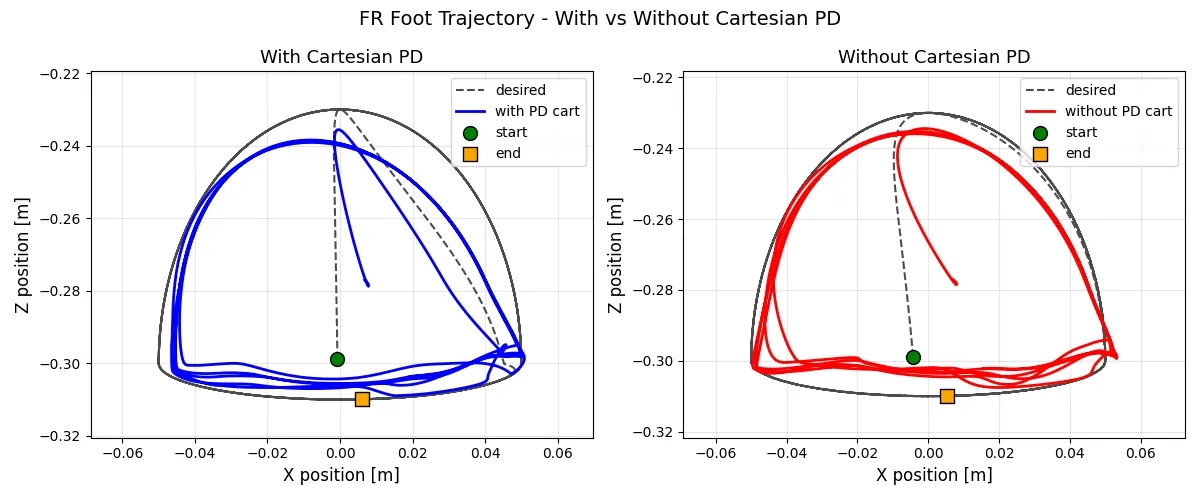
- Nearly 9% better footstep accuracy. We tested multiple action spaces to find the most efficient setup (foot RMS error 2.96 → 2.69 cm, Fig. 04).
- About 2× the reward. With the oscillator states in the observation the policy reached 74.4, against 35.5 without them.
- Natural gaits. The Cartesian action space scored a higher reward but reward-hacked into unnatural gaits; the CPG policy kept an animal-like trot.
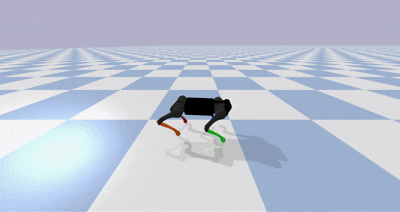
- High speeds. A flat-ground trot at about 1.3 m/s (clip below), and cost of transport fell from 1.37 to 0.825 as speed rose.
Footage & figures
Notes
The Unitree A1 simulation environment, motor model and CPG skeleton came from the course framework. As a team we implemented the oscillator network, the foot controllers, the observation, action and reward design, and every experiment on this page.